

Psychological Safety and Employee Trust in Teams
- Published on: November 22, 2025
Psychological safety and employee trust are no longer “soft” ideas; they’re core Employee Engagement Skills that decide whether teams speak up, collaborate, and perform, or quietly disengage.
Psychological safety is the shared belief that “I can ask questions, share concerns, or admit mistakes here without being judged or punished.”
Employee trust is the confidence employees have that leaders and colleagues will act fairly, honestly, and consistently.

Together, they directly shape employee engagement and performance. Teams that feel safe and trust their leaders contribute more ideas, solve problems faster, and are more resilient in change-heavy environments. Forbes’ research on high-performing teams emphasizes that psychological safety is a critical driver of team performance because it enables moderate risk-taking, creativity, and open conversation.
For HR and L&D, that makes psychological safety and trust central to leadership communication: how leaders listen, share context, and respond when things go wrong. If you’re designing an engagement strategy, both should sit at the heart of your roadmap, alongside your broader program, such as
Employee Engagement Training: A Complete Guide for HR & Managers.
With that foundation in place, we can now unpack psychological safety first, then explore how trust, feedback, and leadership behavior sustain engagement over time.
Understanding Psychological Safety at Work
At its core, psychological safety means employees can speak up without fear of ridicule, blame, or career damage. In a psychologically safe team:
- People can say “I don’t understand” without feeling stupid.
- Mistakes are treated as learning data, not personal failures.
- Junior employees can question decisions made by seniors.
Harvard professor Amy Edmondson defined psychological safety as a shared belief that the team is safe for interpersonal risk-taking and showed that it strongly predicts team learning and performance.
Recent summaries from the CIPD evidence review on trust and psychological safety reinforce this: psychologically safe environments are linked to better team behaviors, stronger relationships, and improved organisational performance.
In practice, psychological safety shows up in small moments:
- A team member calling out a potential risk before a launch.
- Someone flagging that a deadline is unrealistic, instead of silently burning out.
- A new joiner challenging “the way we’ve always done it” without pushback.
When this kind of openness becomes normal, people contribute more fully, and that is where trust starts reinforcing safety and turning it into sustained engagement.
Why Trust Is the Foundation of Employee Engagement
If psychological safety is “Can I speak up here?”, trust is “Do I believe the people around me will respond fairly when I do?”
Employees engage more deeply when they trust that:
- Leaders are honest about what’s happening.
- Workloads, recognition, and opportunities are distributed fairly.
- Their contributions won’t be used against them later.
From an engagement standpoint, trust affects:
- Turnover – High-trust organisations face lower voluntary exits and less quiet quitting.
- Collaboration – People share information and help across teams more willingly.
- Innovation – Employees are more willing to propose new ideas and challenge weak ones.
Gallup data consistently shows that employees who feel their opinions count are significantly more engaged and more committed to innovation efforts. hr.gmu.edu These outcomes show up in your Employee Engagement Score and other HR metrics like eNPS, internal mobility, and performance ratings over time.

When trust is missing, people stop asking questions, stop challenging decisions, and eventually stop caring. That erosion shows up first as subtle behavioural signs, especially in how teams communicate day-to-day.
Signs of Low Psychological Safety in Teams
Low psychological safety rarely starts with a dramatic conflict. Instead, it creeps in quietly through everyday behaviours such as:
- Silent meetings – The same two or three people speak; everyone else nods but rarely contributes.
- Fear of mistakes – Employees triple-check everything, avoid risk, and hide small errors.
- Lack of feedback – Team members don’t ask for or offer feedback because “it won’t matter” or “it’s risky.”
- Surface-level agreement – People agree in the meeting, then disagree privately in chats or email.
- Minimal upward communication – Concerns about workload, process, or ethics never travel upwards.
Recent analysis from Harvard Business also highlights psychological safety as the “hidden engine” behind innovation; when employees fear embarrassment or retribution, they stop raising the very issues that could prevent failure or drive transformation.
Underneath all these symptoms sits a common root: communication breakdown. People don’t feel it’s safe or worthwhile to speak, so they withdraw.
Rebuilding that safety starts with what leaders say and do, especially how transparent they are.
Building Trust Through Transparent Leadership
Trust doesn’t come from big speeches; it’s built through consistent, transparent leadership behavior.
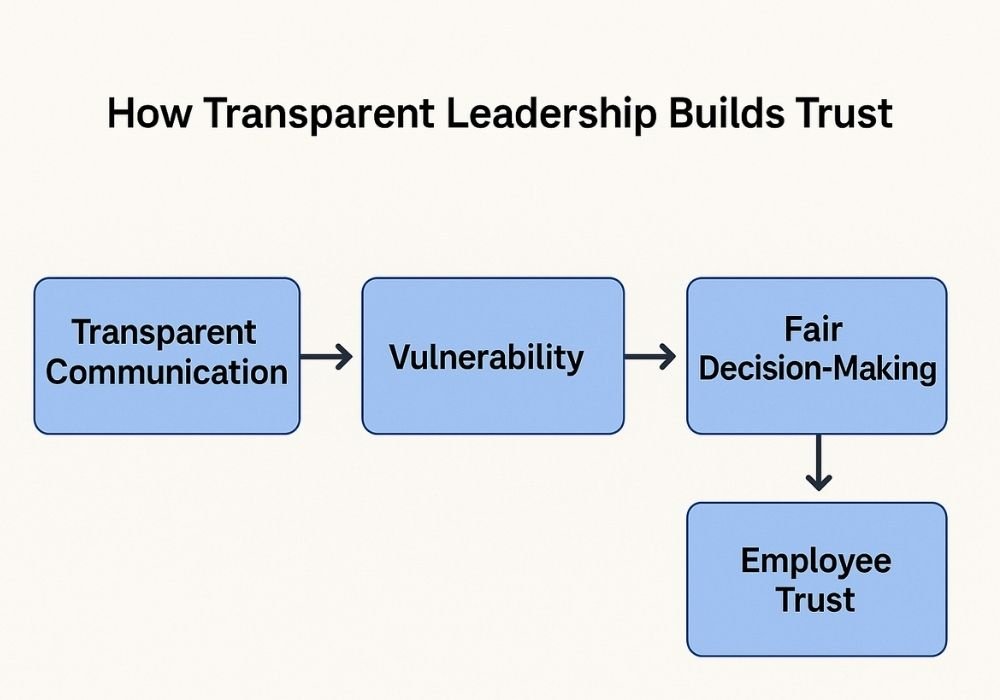
Employees are more likely to trust leaders who:
- Are honest about uncertainty – “We don’t have all the answers yet, but here’s what we know.”
- Show vulnerability – Owning their mistakes instead of hiding them.
- Explain the “why” – Connecting decisions to values, strategy, and data.
- Invite challenge – Genuinely asking for input and not punishing disagreement.
- Follow through – Doing what they say they will do, or explaining why they can’t.
Leadership Skill is inseparable from Employee Trust: how leaders communicate, react to bad news, and model behaviour teaches the team what’s “really safe” to say.
When leaders are transparent, employees feel less need to protect themselves and more energy to focus on work that matters.
For a deeper exploration of how everyday leadership communication shapes trust, see
Leadership Communication: How Managers Build Everyday Trust
Once this trust starts taking root, the next lever is the feedback culture that reinforces it.
How Feedback Culture Builds Psychological Safety
A strong feedback culture turns trust and safety into daily practice. Feedback is not just a performance tool; it’s a signal that:
- “You’re seen.”
- “Your work matters.”
- “You can grow here.”

In psychologically safe teams, feedback looks like:
- Regular recognition – Specific, timely praise for behaviours that align with values and goals.
- Two-way performance conversations – Employees can also share what they need from managers.
- Clear and kind criticism – Focusing on behaviours and process, not personal attacks.
- Peer-to-peer feedback – Normalised, not awkward or rare.
Gallup finds that 80% of employees who received meaningful feedback in the last week are fully engaged, showing how feedback directly fuels motivation and performance.
On the systems side, feedback tools also matter. Statista data on organisations in the Netherlands shows that the top reasons for using online feedback tools include increasing employee involvement (28%) and lowering the barrier to giving and receiving feedback, underlining the link between structured feedback and culture change.
When feedback is:
- Frequent
- Fair
- Future-focused
…it becomes a trust builder instead of a threat.
For practical frameworks and models, you can have a look at
Recognition & Feedback Models: Turning Praise Into Performance.
Still, feedback alone isn’t enough; the way managers deliver it depends heavily on their emotional intelligence.
Emotional Intelligence and the Role of Managers
Emotional intelligence (EQ) is the ability to recognise, understand, and manage emotions, both your own and those of others. For managers, EQ is the difference between feedback that builds people up and feedback that shuts them down.
High-EQ managers:
- Listen actively – They give full attention, paraphrase, and check understanding.
- Show empathy – They acknowledge pressure, context, and personal circumstances.
- Remain fair and calm – Even during conflict or when under stress.
- Adapt communication – They know some employees need directness, others need more context.
- Notice early signs of withdrawal – and proactively check in before disengagement hardens.
High EQ is what enables those behaviours: without it, even well-intentioned feedback can feel harsh, unfair, or unsafe.
When managers combine emotional intelligence with structured feedback and transparent communication, they become culture shapers, not just task owners.
This is exactly where structured learning platforms like Learnerring come in, to make these skills teachable and scalable.
How Learnerring Helps Create Psychologically Safe Teams
Psychological safety and trust aren’t created by a single workshop; they’re built through continuous skill development, especially for managers and team leads. Learnerring helps organisations do this in a structured, measurable way.
Through focused programmes on Employee Engagement Skill, leadership communication, and manager development, Learnerring helps teams:
- Build core engagement behaviours (listening, recognition, follow-through).
- Strengthen leadership communication so messages are clear, honest, and human.
- Develop emotional intelligence in managers through reflection, practice, and feedback.
- Embed feedback rituals into 1:1s, team meetings, and project reviews.
- Align daily leadership behaviour with engagement goals and HR metrics.
You can explore the full curriculum and implementation approach here:
https://learnerring.com/employee-engagement-skill/
When learning is tied directly to real work conversations, how a manager responds to a mistake, how a leader announces change, psychological safety becomes part of the way the organisation operates, not just a value printed on posters.
Conclusion
Psychological safety, trust, and feedback are not three separate initiatives, they are one connected system that sustains employee engagement:
- Psychological safety makes it possible for people to speak up.
- Trust in leadership convinces them it’s worth speaking up.
- Feedback and recognition show that their voice leads to learning, growth, and fair outcomes.
For HR and business leaders, the path forward is clear:
- Invest in Employee Engagement Skills.
- Train managers in leadership communication and emotional intelligence.
- Build systems that make feedback and recognition part of everyday work.
Do that consistently, and psychological safety stops being a concept and becomes a competitive advantage embedded in how your teams think, speak, and perform.
FAQs
The biggest barrier is fear, fear of judgment, punishment, or being perceived as incompetent.
Trust takes time and consistency; most teams see real improvement after several weeks of transparent communication and fair leadership behaviors.
No, psychological safety requires leaders who listen, support risk-taking, and respond calmly to mistakes.
Employees can support safety by sharing openly, giving respectful feedback, and treating mistakes as learning opportunities.
Yes, remote teams with strong psychological safety collaborate better, communicate openly, and show fewer misunderstandings.
Share it :

Soft Skills Courses for Professionals
4.8 / 5.0 Rating
Boost your communication, leadership, and emotional intelligence with practical soft-skill training designed to help professionals excel and grow in the modern workplace.