
Engagement Strategies for Remote & Hybrid Teams: Building Connected Workplaces Anywhere
- Published on: November 20, 2025
The Shift That Changed Everything
The shift from fully office-based work to hybrid and remote cultures didn’t just change where people sit; it reshaped how people connect, communicate, and stay engaged. In a traditional office, engagement happened almost automatically.
You could sense team energy, read body language, overhear updates, and even resolve tension in a hallway conversation. But the moment teams moved to hybrid setups, something else became clear: those natural touchpoints disappeared overnight.
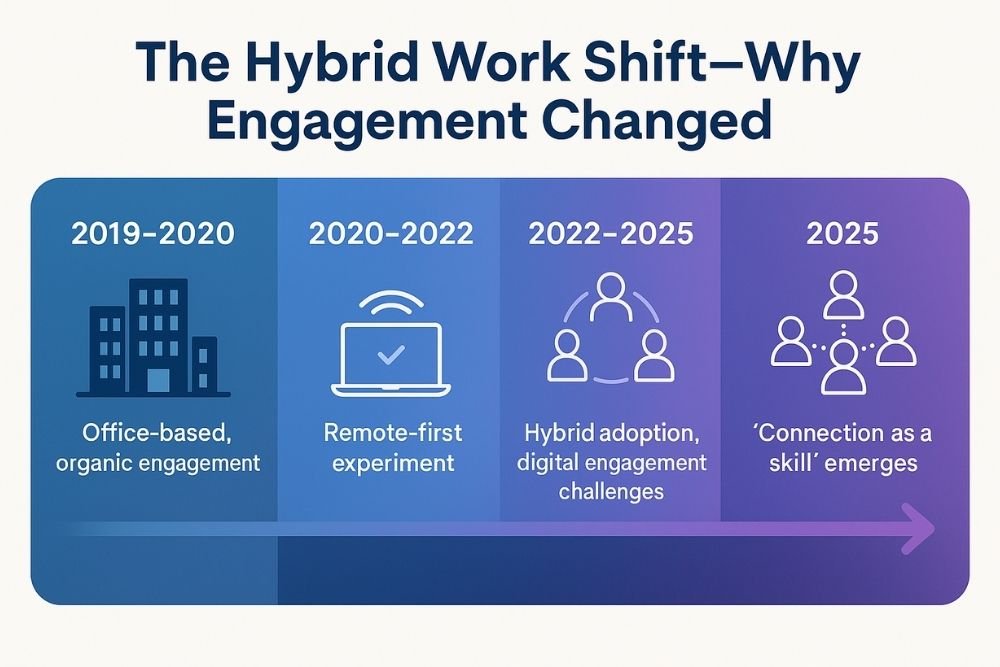
This isn’t just an opinion, even Forbes highlights how hybrid onboarding, connection-building, and early engagement now require intentional frameworks to keep employees emotionally anchored and aligned. Without physical proximity, leaders quickly realized that engagement was no longer a passive outcome. It had to be built deliberately.
That’s why in remote setups, employee engagement skills become more important than ever, especially when you can’t rely on spontaneous interactions. Leaders must communicate more intentionally, teams must collaborate more consciously, and everyone must accept that connection itself is now a skill. A skill that can be taught, developed, and strengthened over time.
If you want to deepen these engagement capabilities within your organization, you can explore our foundational pillar on Employee Engagement Skill Development:
Because once you understand this shift, everything about remote engagement starts to make more sense, especially when you begin looking at how engagement actually behaves in distributed environments.
Which brings us naturally into understanding what engagement truly means when everyone isn’t sitting side-by-side anymore.
Understanding Employee Engagement in Remote and Hybrid Work
Employee engagement in distributed workplaces is the emotional and psychological connection employees feel toward their work, their team, and their organization—despite distance. But distance comes with new challenges that didn’t exist in office environments:
- Less visibility, so contributions go unnoticed
- More isolation, making people feel disconnected
- Asynchronous work, creating delays or misunderstandings
- Context loss, damaging collaboration, and trust
And numbers confirm it. According to Statista’s global remote work analysis, employees working from home report fewer casual interactions and a reduced sense of belonging, which directly disrupts engagement. Similarly, the Microsoft Work Trend Index shows that over 40% of hybrid and remote workers feel less connected to their teammates than before.
This highlights a powerful truth:
Remote engagement thrives on trust, clarity, communication, and intentional connection.
And the first pillar that carries all of this is communication, which becomes the operating system of every distributed team.
Communication as the Core of Remote Team Culture
In a remote culture, communication doesn’t just share information, it replaces physical presence. When teams aren’t in the same room, communication becomes the only way to feel connected, aligned, and informed.
That’s why communication in distributed teams must be:
- Structured, through planned check-ins
- Open, with channels people can rely on
- Clear, so assumptions don’t derail progress
Tools like Slack keep conversations flowing, Notion ensures asynchronous visibility, and Loom adds the human element back through quick video walkthroughs that replicate “tap on the shoulder” moments.
And when communication is predictable and transparent, something powerful happens:
Consistency builds culture.
And once communication is consistent, it becomes easier to recognize and celebrate contribution, the next essential driver of remote engagement.
Recognition and Feedback in a Hybrid Work Environment
Hybrid environments require recognition to be more intentional, more visible, and more frequent. Gone are the days when a manager could casually thank someone in the hallway. Now, leaders must create recognition loops that travel through digital channels:
- Public Slack shoutouts
- Digital badges
- Team-wide appreciation moments
- Social mentions
- “Win of the week” updates
- Peer-to-peer praise
Why? Recognition is one of the few ways remote employees feel seen.
And research backs this. Studies published on ResearchGate show that recognition and appreciation significantly increase motivation, ownership, and performance, especially when employees feel physically disconnected or under-noticed.
For deeper frameworks on recognition process design, you may check out our- Recognition & Feedback Models Guide
Because in distributed environments, recognition isn’t a luxury, it’s the fuel that keeps motivation alive.
Recognition sustains motivation even without physical presence.
And once recognition is established, the next step is creating the psychological conditions that make teams feel safe speaking up, and that’s where trust becomes central.
Building Psychological Safety and Trust in Remote Teams
Psychological safety is the belief that team members can speak up, ask questions, admit mistakes, and share new ideas without fear. And in remote teams where silence is common and misunderstandings are easy, psychological safety becomes even more essential.
This isn’t a soft concept either. Google’s Project Aristotle, which examined over 180 teams, found psychological safety to be the #1 predictor of high performance. In remote teams, leaders show psychological safety by:
- Acknowledging uncertainty
- Inviting input
- Responding with empathy
- Being transparent
- Showing vulnerability
Trust isn’t abstract, it can be measured through engagement surveys, participation metrics, and sentiment feedback. And when trust rises, collaboration skyrockets in distributed settings.
For deeper insights on trust-building, explore our Blog on Trust in Distributed Teams.
And once trust is in place, tools and rituals become the structure that keeps engagement habits alive every week.
Tools and Rituals That Strengthen Employee Engagement
Digital tools keep remote teams running smoothly, but rituals keep them emotionally connected. You need both.
Tools that support engagement:
- Teams for collaboration
- Zoom for virtual meetings
- Asana for accountability
- Notion for async knowledge sharing
Rituals that build connection:
- Morning stand-ups
- Weekly shoutouts
- “Friday Wins”
- Virtual coffee breaks
- Monthly recognition circles
- Social connection moments
These rituals create continuity in a world where everyone works differently and from different places.
Rituals build continuity,
Continuity builds belonging,
Belonging sustains engagement.
And once these rituals are in place, measuring whether they work becomes the next logical step.
Measuring Employee Engagement and Connection in Distributed Teams
Engagement doesn’t improve by accident, it improves when teams measure it intentionally.
Useful hybrid engagement metrics include:
- eNPS (Employee Net Promoter Score)
- Pulse survey participation
- Meeting engagement levels
- Peer recognition frequency
- Collaboration patterns
To master measurement frameworks, one amy have a look at our guide on How to Measure Employee Engagement ROI .
One of the most powerful indicators is the Engagement Score, which captures emotional connection, communication rhythm, participation, and psychological safety collectively.
And once leaders see these numbers clearly, the human side of leadership becomes the final piece that elevates engagement from good to exceptional.
The Human Element: Emotional Intelligence and Leadership in Remote Teams
When teams work remotely, emotional intelligence becomes the core leadership skill. Without in-person cues, leaders rely on tone, timing, clarity, and empathy to maintain psychological closeness.
Emotionally intelligent leaders:
- Listen without judgment
- Adapt communication to individual needs
- Encourage feedback
- Ask thoughtful questions
- Create safe digital spaces
This is part of the broader idea that connection is a skill, and it can be developed through training.
If you want to strengthen these leadership behaviors, you can explore our
Employee Engagement Skill Development Program: https://learnerring.com/employee-engagement-skill/
And once leadership embraces EQ, structured learning becomes the bridge that brings all these engagement elements together.
How Learnerring Helps
Learnerring helps organizations build engagement as a teachable, repeatable capability. Our program goes beyond theory, turning communication, recognition, psychological safety, and leadership EQ into daily habits—no matter where your teams work.
You can explore the full course here:
https://learnerring.com/employee-engagement-skill/
And once teams learn these skills, engagement becomes consistent, scalable, and long-lasting, bringing us to our final takeaway.
Conclusion
Remote and hybrid teams don’t thrive because of location, they thrive because of connection. When communication is clear, recognition is intentional, psychological safety is strong, and leadership is emotionally intelligent, engagement becomes a natural rhythm instead of a forced initiative.
Connection + Communication + Recognition + Trust + Rituals + Leadership EQ = Engaged Teams Anywhere
And when you treat engagement as a skill, not a checkbox, it becomes a lasting competitive
FAQs
Remote employees stay engaged when communication is clear, recognition is consistent, and leaders show emotional intelligence. Engagement in remote work is built through trust, meaningful check-ins, and purposeful connection.
Most hybrid employees feel disconnected because casual office moments disappear. Without visibility, spontaneous conversations, or shared context, connection fades unless teams intentionally build rituals that replace in-office interactions.
Managers build trust through transparent communication, predictable check-ins, empathy, and psychological safety. When people feel safe to speak up and share ideas, trust naturally grows in distributed teams.
Simple activities include “Friday Wins,” virtual coffee chats, team shoutouts, micro-learning circles, and async Loom updates. These small rituals add rhythm and belonging to remote work.
Communication is everything in hybrid work. It replaces physical presence, maintains clarity, and keeps teams aligned. When communication is consistent, remote team culture becomes stable and predictable.
Emotional intelligence, empathy, adaptability, and active listening are the core leadership skills that drive engagement in hybrid and remote cultures.
Absolutely. Tools like Slack, Teams, Notion, and Zoom make communication smoother, increase visibility, and support the rituals that keep remote teams connected.
Share it :

Soft Skills Courses for Professionals
4.8 / 5.0 Rating
Boost your communication, leadership, and emotional intelligence with practical soft-skill training designed to help professionals excel and grow in the modern workplace.