
How to Measure Employee Engagement ROI in 2026
- Published on: November 12, 2025
Employee engagement has shifted from being a “nice-to-have HR initiative” to a data-driven business strategy. As highlighted by Forbes’ analysis on why employee engagement is essential, organizations that treat engagement strategically outperform those that treat it as an HR add-on. Y. Yet, HR leaders still struggle to prove that engagement truly impacts the bottom line.
Let’s break it down like practitioners, with data, emotion, and real-world context, to see how engagement converts into ROI, and why training, recognition, and psychological safety are the silent growth multipliers hiding behind every healthy culture.
Why Proving ROI on Engagement Is Difficult for HR
If you’ve ever presented an engagement survey to your CFO, you know the look, polite interest, followed by the question: “But what did this actually return?”
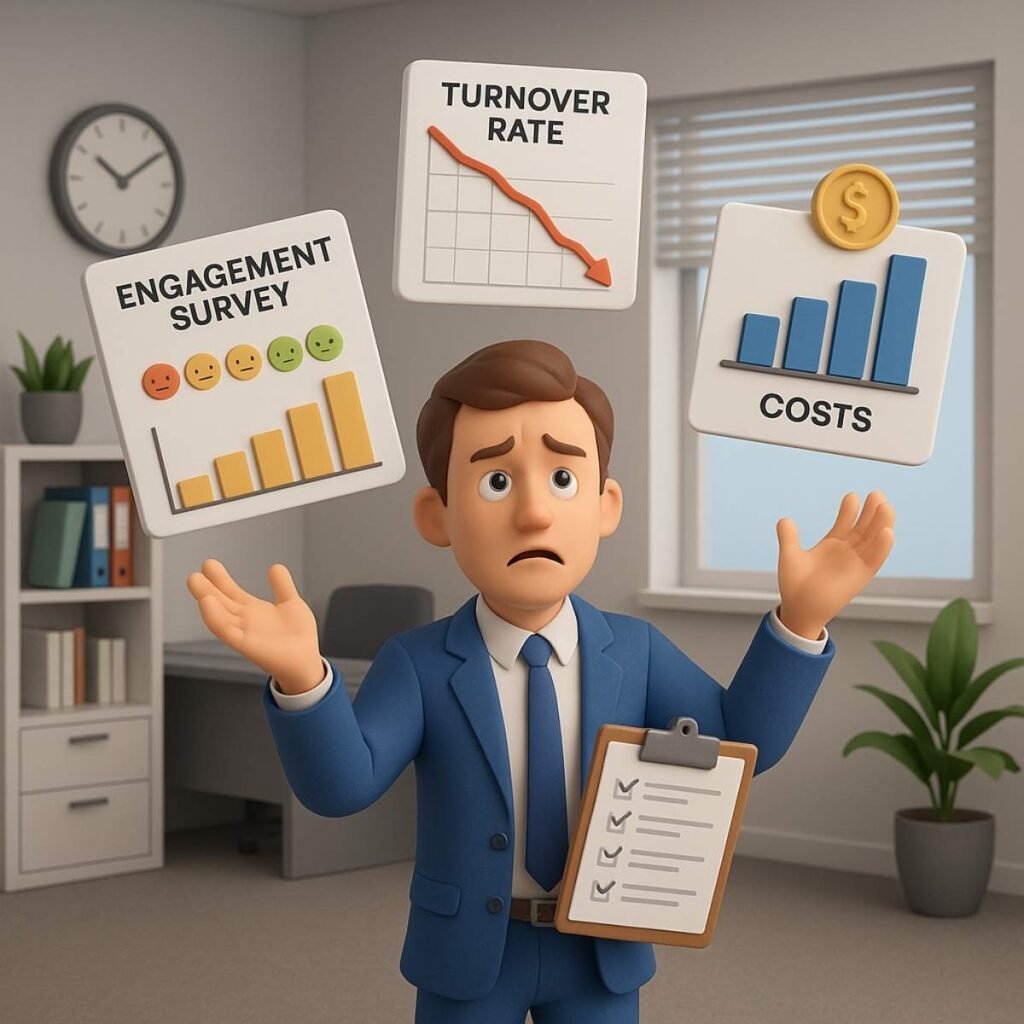
The challenge is that engagement touches intangibles: trust, recognition, belonging, and leadership quality. You can feel it, but can you quantify it? Engagement improvements often run parallel with turnover drops or performance gains, but correlation isn’t always obvious.
That’s where a data-backed framework changes the game. When HR connects sentiment data (like eNPS or pulse trends) with measurable outcomes (like productivity, customer NPS, or cost per hire), you stop justifying engagement and start monetizing it.
ndustry data reinforces this. According to Statista’s workplace learning and development insights, organizations that invest in employee development experience stronger retention, deeper skill adoption, and measurable improvements in performance—all key contributors to engagement ROI.
Training plays a key role here. Well-designed Employee Engagement Training programs help HR teams embed analytics, build feedback culture, and align leadership behaviors with measurable outcomes. They turn abstract “culture programs” into profit levers.
Key Metrics That Define Employee Engagement ROI
1. Employee Net Promoter Score (eNPS)
eNPS asks, “How likely are you to recommend our company as a great place to work?”
It measures loyalty and internal advocacy, two leading indicators of retention and performance.
When employees become promoters of their workplace, you see it in reduced attrition and stronger customer experience. According to Gallup’s research on engagement ROI, organizations in the top quartile of engagement outperform peers by 21 % in profitability and 17 % in productivity.
Recognition directly fuels eNPS. When managers celebrate wins consistently (see Recognition & Feedback Models), employees feel seen, and advocacy grows naturally.
2. Pulse Surveys: Real-Time Sentiment Tracking
Pulse surveys are like engagement heartbeats, short, frequent, and revealing.
They allow HR to spot morale dips before they snowball into exits. For instance, if pulse participation drops or “trust in leadership” scores decline, that’s a predictive signal of disengagement.
Platforms like CultureMonkey show how continuous listening translates into tangible ROI by surfacing sentiment in real-time and enabling immediate manager action.
3. Turnover Rate: The True Cost of Disengagement
Every exit costs money, recruiting, onboarding, productivity loss. The SHRM turnover cost study estimates each replacement at 50–200 % of annual salary.
By tracking turnover alongside engagement interventions, HR can assign real value to culture improvements. For example, a 5 % reduction in attrition can offset the full annual cost of your engagement initiative, a clear, boardroom-ready ROI story.
4. Engagement Score: Motivation in Motion
An engagement score aggregates motivation, purpose, alignment, and recognition into a single index.
When you correlate a rising engagement score with improved productivity or quality metrics, you have proof of causation, not just correlation.
Tools like Betterworks and WorkTango make it easy to visualize this data, turning “soft feedback” into hard evidence of ROI.
Measurement Framework: How HR Teams Quantify Engagement Success
Think of the Engagement Measurement Framework (EMF) as your ROI GPS, it tells you where you started, what you changed, and how far you’ve come.
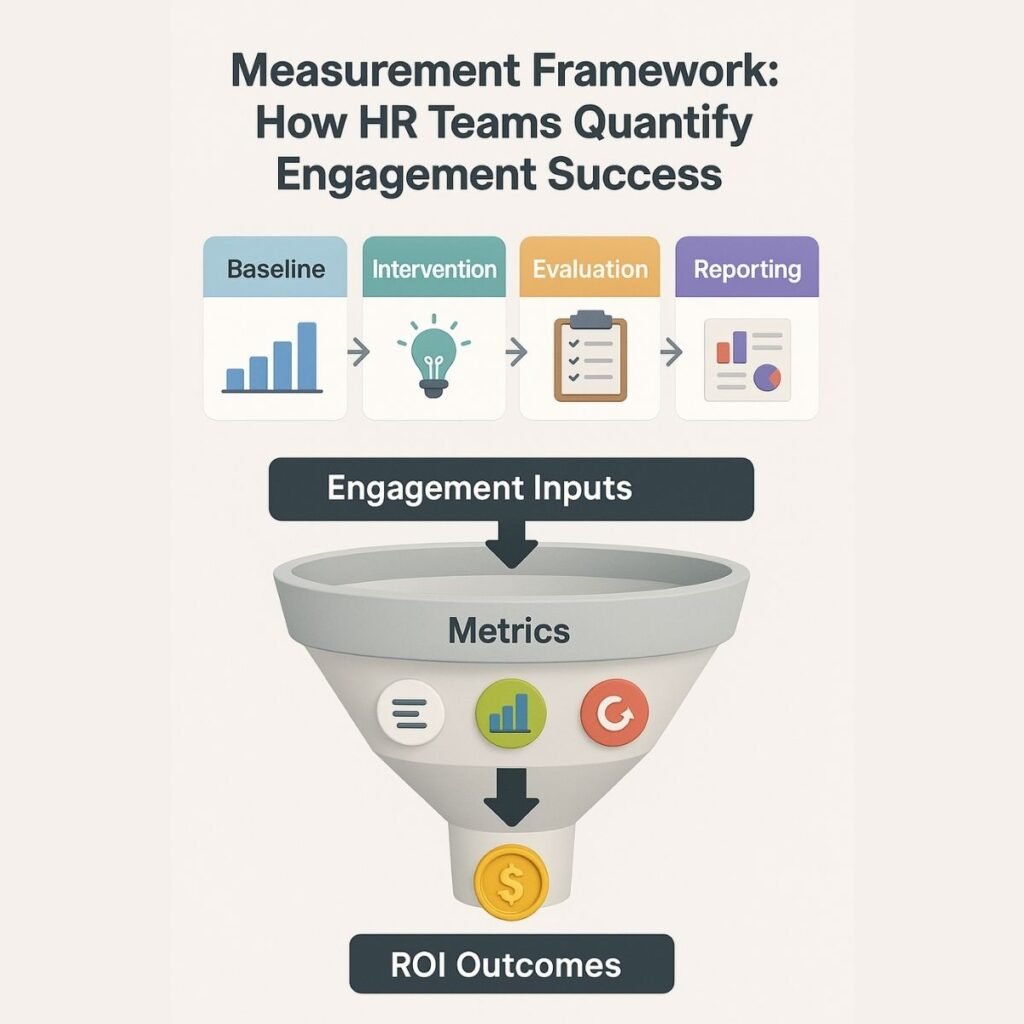
Step 1 – Baseline
Measure everything that matters before you intervene: eNPS, engagement score, turnover, absenteeism, and trust levels. Trust is especially vital, low psychological safety (explored deeper in Psychological Safety and Employee Trust in Teams) can silently erode every other metric.
Step 2 – Intervention
Deploy specific engagement levers: manager-feedback training, recognition frameworks, flexible-work adjustments, leadership check-ins. Note every initiative’s start date and scope, this helps you trace later ROI.
Step 3 – Evaluation
After 3–6 months, re-measure. Look for metric shifts and link them back to actions. Did your eNPS rise? Did turnover fall? Are employees taking more pulse surveys? Tools like Leapsome’s ROI Calculator can help quantify financial outcomes.
Step 4 – Reporting
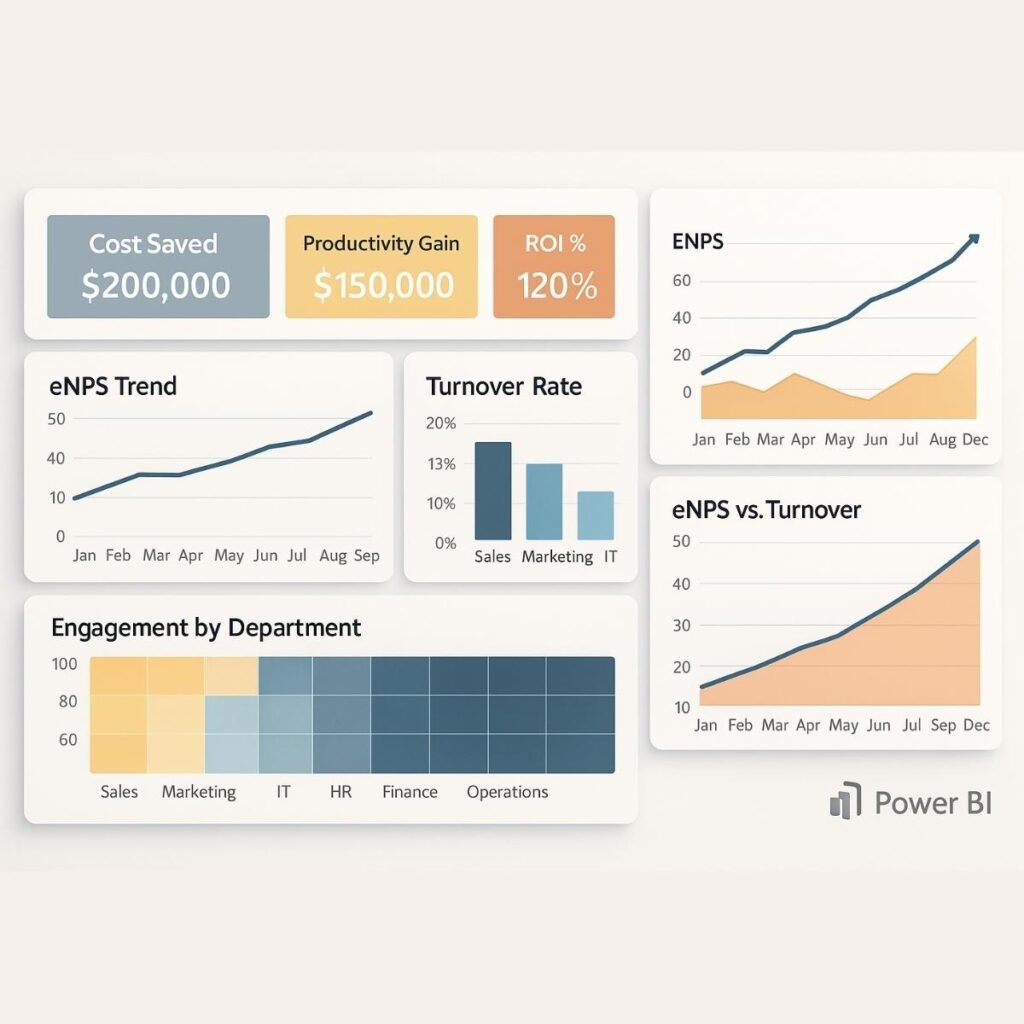
Now visualize your findings. Build a dashboard that ties human sentiment to business metrics:
- eNPS → Retention → Cost Savings
- Engagement Score → Productivity → Revenue Growth
As highlighted in WorkTango’s ROI Insights, storytelling through data converts HR insight into executive confidence.
Learnerring’s Employee Engagement Training Program includes a practical measurement module that helps HR teams implement this framework and present results confidently.
Data Visualization Example: Turning Metrics Into Insights
Case Study — AstraWorks Technologies (2026)
|
Metric
|
Before (Q1)
|
After (Q4)
|
Change
|
|---|---|---|---|
|
eNPS
|
22
|
38
|
+16 pts
|
|
Turnover
|
15 %
|
9 %
|
–6 ppts
|
|
Engagement Score
|
67
|
83
|
+16 pts
|
|
Pulse Participation
|
49 %
|
76 %
|
+27 pts
|
ROI Outcome: With turnover savings of $18 lakhs and productivity gains worth ₹$lakhs, AstraWorks realized a 3.4× ROI on its engagement initiative.
Measuring Engagement in Distributed Teams
Remote and hybrid workforces require different engagement lenses. You can’t measure “smiles in hallways,” so you measure participation, recognition, and connection instead.
- Asynchronous surveys: Schedule pulse surveys across time zones to boost response equity.
- Digital recognition frequency: Track peer shout-outs and kudos in Slack or Teams as engagement proxies.
- Collaboration analytics: Review how often remote teams contribute to cross-functional projects.
- Connection Index: Combine recognition + collaboration + feedback data to map “team connectedness.”
When you apply these data points within the EMF model, you’ll prove that remote teams can be more engaged and more profitable than traditional setups.
How Employee Engagement Training Improves ROI Scores
Training is the thread that stitches every metric together.
When leaders learn to give meaningful feedback, employees feel valued. When teams understand how engagement data works, they take ownership of improving it. The result? Better eNPS, higher participation, and reduced churn.
For example, “Training improves engagement scores by strengthening leadership communication and feedback culture.” It builds the emotional competence that fuels measurable business results.
Cross-reference with Recognition & Feedback Models That Boost Engagement for actionable techniques and see how feedback frequency alone can raise engagement by double digits.
How Learnerring Helps
At Learnerring, our Employee Engagement Skill Course transforms HR data into business intelligence. It helps you:
- Build your Engagement Measurement Framework from scratch.
- Connect recognition, trust, and hybrid-team analytics to financial ROI.
- Create clear dashboards and executive reports that tell the “people-to-profit” story.
Every concept you’ve read above, from pulse survey timing to turnover cost modelling, is taught hands-on through our training modules, so your team doesn’t just collect engagement data; they activate it.
People Also Ask
The measurable financial impact of improved motivation and retention.
By linking eNPS, turnover, engagement score, and productivity metrics to interventions.
Engaged teams perform better, stay longer, and drive higher profitability.
Pulse surveys, engagement dashboards, and turnover analytics.
By strengthening leadership habits that influence morale and performance.
Share it :

Soft Skills Courses for Professionals
4.8 / 5.0 Rating
Boost your communication, leadership, and emotional intelligence with practical soft-skill training designed to help professionals excel and grow in the modern workplace.